
Reaction to fire of coated technical textiles: the various evaluation tests
Introduction
The fire behaviour of coated fabrics is a very important criterion for determining their conditions of use, as these textiles are very widely used, particularly in enclosed spaces where the risk of fire and the potential presence of a large number of people can lead to large-scale disasters. As the vast majority of coated fabrics are composed of organic polymers, they are by default combustible and liable to spread a fire rapidly.
A coated fabric is a thin, flexible composite material: the substrate (polyester, glass) and the coating (PVC plastisol, PU, acrylic) react differently to a flame. Polyester melts and shrinks, glass does not burn, but the coating is more or less combustible. To improve fire behaviour, the formulation of coated fabrics is modified to incorporate fire-retardant materials that act on 3 parameters:
Cooling of the flame and the material
Inhibition/slowing down of the chemical combustion reaction
Creation of a physical barrier layer that prevents oxygen from reaching the flammable materials (or dilutes it)
The coated textile modified in this way does not become non-combustible, but becomes more or less difficult to ignite, no longer spreads fire, and has a tendency to extinguish itself once ignited if conditions allow.
To evaluate the fire resistance of coated fabrics, two test methods are mainly used in Europe: the M classification and the Euroclasses. The M classification is of French origin, but is very old and has established itself as a reference far beyond French borders. Although it is in principle superseded by the Euroclasses, which have European recognition, it remains very widely used.
M Classification (NF P 92-503 and associated tests)
Scope. The M classification (M0 to M4) is a French system, defined by the decree of 21 November 2002 and the NF P 92-507 standard. M0 denotes a non-combustible material, M1 non-flammable, M2 flame-retardant, M3 moderately flammable, M4 easily flammable. It remains widely used for wall hangings, curtains, tents, and structures. The M1 & M2 classifications are the only ones relevant for coated fabrics. The M classification is specified for public access buildings (ERP) as well as transport vehicles. For rail transport, however, the EN 45 545 standard is the reference.
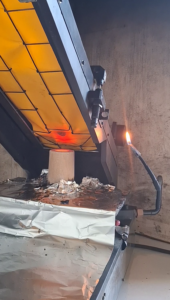
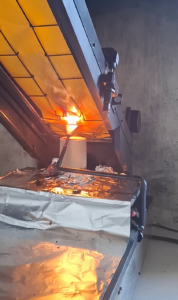
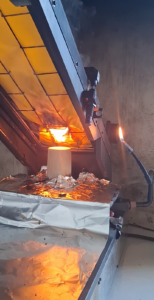
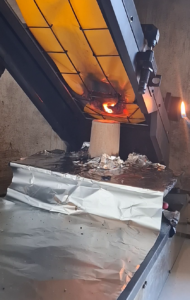
Test principle. NF P 92-503 is the ‘electric burner’ test intended for flexible materials with a thickness of 5 mm or less (and therefore all coated fabrics). The test specimen, mounted on an inclined support, is exposed to heat from an electric radiator and a flame, which ignites the textile at regular intervals. The pictures show the various steps of the test.
Observations are made of ignition, the duration of combustion with a flame, and the extent of the destruction of the textile. This test differs from other fire resistance tests due to the prior heating of the fabric by the electric burner before ignition by the application of the flame.The objective is to simulate actual fire conditions, where the materials are subjected to heat radiation from the fire before being ignited themselves.
A complementary test (NF P 92-504), used if the fabric melts or generates flaming droplets during the electric burner test
Criteria. The classification is obtained by comparing these observations against thresholds: M1 requires the absence of propagation and flaming droplets, with a very short extinction time after the flame is removed (< 5 seconds). M2 tolerates limited propagation, while M3 and M4 represent much lower requirements, and materials in these classes are considered non-fire-retardant.
Relevance. This is a small-scale, rapid, and reproducible test, well-suited to thin materials. On a PVC coating, M1 can be achieved on certain substrates without antimony oxide, thanks to mineral fillers and phosphorus-based plasticisers or additives; polyurethane is more demanding, as the heat of combustion is higher than that of PVC (the chlorine atom, which accounts for 57% by mass of PVC, contributes significantly to reducing the combustibility of PVC). In practice, PVC alone barely burns; it is the plasticiser added to give it flexibility that contributes to its combustibility. The substrate also contributes significantly to combustion depending on its nature (organic or mineral) and the relative proportion by weight of the substrate and the coating.
Euroclasses (NF EN 13501-1)
The EN 13501-1 standard classifies the reaction to fire of construction products throughout the European Union: A1, A2, B, C, D, E, F, supplemented by two indices, smoke production (s1 to s3) and flaming droplets or particles (d0 to d2). It applies to textiles used in the building industry (architectural membranes, tensioned facades, blinds, flexible cladding).
Several tests are combined depending on the target class:
EN ISO 1182 and EN ISO 1716 (classes A1 and A2): furnace at 750 °C for non-combustibility, and bomb calorimeter for the gross calorific value (GCV). Class A2 requires an average GCV of approximately 3 MJ/kg at most.
EN 13823 (SBI, Single Burning Item) (classes B to D): a corner of two panels is exposed to a 30 kW burner. Heat release rate (FIGRA), total heat release (THR600s), smoke (SMOGRA, TSP600s), lateral spread, and droplets are measured.
EN ISO 11925-2 (classes B to E): exposure to a small 20 mm flame, with observation of flame spread over 150 mm.
This is the most comprehensive standard and the only one recognised throughout the EU. The classification also depends on the mounting configuration and the substrate: it is only valid for the tested condition of use, hence the importance of extended application rules (EXAP). A flame-retardant PVC-coated fabric typically aims for B-s2,d0 or C-s2,d0; class A2 is generally only feasible for a glass fabric with a thin coating, due to the high calorific value of the plasticisers and, to a lesser extent, the PVC.
Other fire resistance tests:
The two standards described above apply essentially to construction materials. There are also numerous methods for evaluating fire behaviour forspecific applications, which are used to varying degrees depending on the sector or country. We cite only a few examples:
UL 94: a standard of American origin that characterises the ignition of plastic materials intended for parts of electrical and electronic equipment, sometimes used to test coated fabrics.
ISO 3795 (or its equivalent FMVSS 302): a very simple horizontal burning rate test, used for materials inside vehicles. A limit of less than 100 mm/min is commonly recognised as relevant.
ISO 6941: also a very simple test, but more severe than ISO 3795, because combustion propagates better in the vertical direction (natural orientation of the flame). It is a fairly relevant test for testing curtains or any other textile used in a vertical position, but much more basic than the EN 13773 system, which uses 3 distinct tests depending on the results.
DIN 4102-1: This is the German standard for construction materials, superseded by the Euroclasses, which refers to two tests to classify the textile (like the M classification which uses up to 3 distinct tests).
Conclusion: There are therefore numerous methods for characterising the fire behaviour of coated textiles. Many of these methods aim to simulate a very specific environment using simple tests, focusing on the rate of extinction or the rate of combustion propagation. Characteristics such as smoke release or heat production are measured much less frequently. However, in the majority of cases, these simple tests provide a fairly accurate idea of a textile’s fire behaviour in a given application, and thus allow for better risk management.